

Continuing Obligations
Compliance with the JSE LR
All announcements make use of SENS, and where required, summarised press disclosure. All information announced on SENS effects full disclosure into the public domain.
A ListCo (Main Board and ALTx) must comply with the JSE LR on a continual basis, even if there is an overlap with another law. Such overlap often involves the Cos Act and may require two separate approvals for the same CA.
A ListCo must have an appointed sponsor at all times. Refer to "Sponsors – Section 4" in the table above for commentary.
General Obligation of Disclosure – Section 6.19
ListCo must draft an information policy dealing with all principles concerning measurement, classification and disclosure of information ("Information Policy").
PSI is unpublished information that is known with reasonable certainty and is deemed to have a material effect on ListCo's traded security price ("security price") when published on SENS. Information arising from CAs and unusual in the ordinary course of business ("ITOCOB") events ("Events") must be determined as being PSI or not.
Information will pre‑qualify as PSI if it is deemed (by ListCo) to have a material effect on ListCo's security price. "Material effect" does not rely upon the definition of "material" in the JSE LR, which as a rule of thumb, is 10%. A reasonable measurement level for a material effect is any deemed increase or decrease in ListCo's share price of 5% or more, determined using the measurement metrics of size and importance. Assuming a material effect of 5%, the size measurement metric will deem any information to pre‑qualify with respect to a CA or Event if the monetary size of the subject matter concerned is equal to or greater than 5% of ListCo's market capitalisation. Any information that does not pre‑qualify as PSI in terms of size (i.e. monetary size is less than 5% of ListCo's market capitalisation) will pre‑qualify if it is decided by ListCo that market perception and reaction to such information disclosure would have a material effect on ListCo's security price.
Pre‑qualified PSI will (finally) qualify as PSI when the probability of success of a CA or Event achieves "reasonable certainty". Reasonable certainty is achieved when the probability of success is greater than 50% with no other competing probable outcomes of any material size.
There are, therefore, two steps required to qualify information as being PSI: firstly, it must be deemed to have a material effect on ListCo's security price and then, secondly, it must become reasonably certain that the CA or Event will occur. When ListCo is in possession of PSI, it is in a Price Sensitive Period.
Inside Information and the linkage to PSI – FMA Sections 77 to 82
The FMA defines Inside Information as information concerning ListCo, which if it were made public, would be likely to have a material effect on ListCo's security price, or on any JSE-listed derivative security in respect of any of ListCo's shares. As there is no definition of "material" in the FMA, Inside Information is deemed to be the same as PSI.
Any Price Sensitive Period is therefore deemed to also be an Inside Period and all principles with respect to PSI apply, mutatis mutandis, to Inside Information.
Any person who receives Inside Information concerning ListCo becomes an Insider and if it/they commit an Insider Trading offence they are liable to up to a maximum civil liability of four times the profit made (or loss avoided) plus a R1 million penalty increased by the rate of CPI from June 2013.
Separately, criminal sanction for, inter alia, Insider Trading carries up to 10 years in jail and/or up to a R50 million fine.
The Insider Trading offences and defences are summarised as follows:
| Offence 1 | Offence 2 | Offence 3 | Offence 4 | Offence 5 | |||||||||||
|
|
|
|
|
Insider trading laws are fairly similar throughout the Western world.
Confidentiality and announcements – Sections 6.20 to 6.25
Confidentiality of PSI (and Inside Information) is a myth. It will almost always be breached due to the ever- increasing number of persons becoming aware of such information over time who are not formally recorded as Insiders.
However, in order to maintain a manageable existence, ListCo will presume confidentiality is maintained provided ListCo is unaware of any overt PSI disclosures having been made to non-Insiders ("disclosure breach") and if ListCo's traded share volumes and share prices do not deviate by an amount that is deemed to be indicative of a breach. Share volume and price movements of 5% or more from 20-day moving average volumes or prior day closing prices are reasonable pre-indicators of a breach of confidentiality.
Any pre-indicated disclosure breach must be immediately investigated and a determination made whether any volume or price move(s) can be explained by, or attributed to, general market forces such as a general market increase or decline, increase or decline of peer group ListCos volumes and/or prices, increase or decrease in Rand exchange rates, commodity price movements, etc. – and if no such explanation or attribution appears to be reasonable – then a disclosure breach must be assumed to have occurred.
After any overt or assumed disclosure breach has occurred, ListCo must immediately contact (within minutes) any involved counter party/ies ("counter parties") and inform such counter parties of the disclosure breach and of ListCo's obligation to immediately announce (probably within an hour) all known facts, including naming the counter parties, concerning the ITOCOB Event or CA on SENS. Provided the counter parties agree, ListCo must then proceed to contact its sponsor and brief the sponsor to draft and release a detailed Cautionary Announcement on SENS and in the Press. If the counter parties do not agree, then ListCo must either terminate negotiations with the counter parties and brief the sponsor to draft an explanatory announcement on SENS and in the Press stating that ListCo is not involved in any PSI negotiations or agree with the counter parties that negotiations will not be terminated and must immediately apply to the JSE for a suspension of ListCo securities trading. In the event of a suspension of ListCo securities trading, negotiations must be concluded within days, and ListCo must then announce either a detailed Cautionary Announcement or explanatory announcement on SENS and in the Press and apply for a resumption of share trading.
Cautionary Announcements require further Cautionary Announcements to be published every 30 bd in order to apprise the market of progress concerning the CA.
All announcements, and particularly Cautionary Announcements because of their information-sensitive nature, must disclose all material facts that are known with reasonable certainty at the date of announcement in compliance with Section 81 of the FMA. Accordingly, the JSE LR prohibit "bland" cautionary announcements.
It is important to note that confidentiality overrides reasonable certainty, but that certainty (100%) overrides confidentiality, which is why PSI does not need to be announced in a Cautionary Announcement when confidentiality is maintained and why "terms" must be announced immediately when agreement is reached.
Publication of Trading Statements – Section 6.26 to 6.33
Trading Statements apply to two separate financial periods, firstly, to the interim period ending/ended with respect to the six-month interim period results and secondly, to the full financial year ending/ended with respect to the 12-month financial year results. Each Trading Statement is mutually exclusive of the other.
ListCo's consolidated earnings per share ("EPS") and headline earnings per share ("HEPS ") must be calculated on a monthly basis. Alternatively, if ListCo is a Property Entity it may use distribution per share ("DPS") after announcing such base line information usage via SENS.
ListCo's monthly consolidated EPS and HEPS (or DPS) must be used as a basis to internally forecast EPS and HEPS (or DPS) for two separate financial periods:
- firstly, with respect to the interim period ending/ended – to the end of such interim period ("interim forecast"); and
- secondly, with respect to the second half of the financial year – to the end of the financial year ending/ended for the full financial year ("financial year forecast").
The respective interim forecast and financial year forecast must be compared either:
- to the respective prior year's interim or financial year's historical EPS and HEPS (or DPS) in cents; or
- to forecast EPS and HEPS (or DPS) in cents that have been published for the current interim period or current financial year ("base line information").
When the respective interim forecast or financial year forecast is expected, with reasonable certainty, to be greater than or less than the relevant base line information by 20% or more with respect to EPS or HEPS or 15% or more with respect to DPS, a Trading Statement is required to be published on SENS.
The Trading Statement must disclose either:
- if range based – the relevant base line information, the forecast range of EPS and HEPS (or DPS) in cents and the percentage range increase or decrease (if equal to or less than 100%) compared to the base line information, and such range may not exceed 20% of the base line information [Guidance Letter 20 September 2018 indicates that range must be as specific as possible and not simply rely on 20%]; or
- if minimum based – the relevant base line information, the forecast minimum EPS and HEPS (or DPS) expected and the minimum percentage increase or decrease (if equal to or less than 100%) compared to the base line information. Where such minimum percentage Trading Statement is disclosed, further "minimum" Trading Statements are required until, finally, a Trading Statement is published with a range followed by publication of the financial results.
ListCo must determine from historical publication of results what EPS and/or HEPS (or DPS) percentage increase or decrease level(s) resulted in a material effect on ListCo's security price. When such a reasonably certain forecast of EPS and/or HEPS (or DPS) is reached in a relevant Trading Statement period, ListCo is in a Price Sensitive Period and must apply all PSI principles.
The publication of a Trading Statement provides the market with an update of all financial PSI and therefore automatically results in the cessation of a Price Sensitive Period that arose from ITOCOB trading conditions. The publication of a Trading Statement does not give rise to a Cautionary Period or a Financial Closed Period.
ListCo may voluntarily publish a Trading Statement at a lower forecast EPS and/or HEPS (or DPS) threshold than the 20% or 15% level in order to terminate a Price Sensitive Period.
The above applies to new ListCos post-initial listing, irrespective of whether prior year financial results were published in the PLS/prospectus.
Forecast financial information, excluding Trading Statements – Section 11
Forecast financial information is "triggered" by any statement or announcement referring directly or indirectly (i.e. financial data requiring interpretation and calculation – so‑called "mosaic theory") to any future period profits or losses and which contains EPS or HEPS (or DPS) disclosure or from which EPS or HEPS (or DPS) can be reasonably expected to be calculated.
The JSE has combined a Specific Profit Forecast and a General Profit Forecast. Any disclosed forecast financial information must have been properly compiled in accordance with IFRS principles. However, the two concepts do still come into play in terms of assurance.
Specific Profit Forecast
A Specific Profit Forecast is a forecast that discloses EPS and HEPS as a number, percentage, range of numbers or percentages, or a minimum or maximum for a future period ending or for a period ended but not yet reported upon.
Trading Statements are classified as Specific Profit Forecasts.
A Specific Profit Forecast, excluding Trading Statements, is usually published on a voluntary basis and may be included in a periodic financial information report or separately on SENS. Certain CAs require publication on SENS and in a Circular, PLS, Revised Listing Particulars ("RLP") or in a prospectus.
If a Specific Profit Forecast is included in an announcement only, usually in an interim report, or post financial year end in a Results Announcement (and then in the Annual Report/Integrated Report ("AR/IR") but not in the Annual Financial Statements ("AFS")) it requires only ListCo directors' approval.
If a Specific Profit Forecast is disclosed in or referenced from a SENS announcement only, being either a standalone announcement or Results Announcement referencing Interim Financial Statements, Condensed AFS, Consolidated AFS, Consolidated AFS together with Company AFS or the AR/IR ("Financial Documents"), it requires only ListCo directors' approval. Accordingly, to avoid an auditor review, disclosure will be in that part of a Financial Document that is not covered by the relevant auditor scope paragraph.
If a Specific Profit Forecast is published in that part of a Financial Document that is covered by the auditor scope paragraph, a Circular, PLS, RLP or Prospectus, it requires ListCo directors' approval and must be auditor‑reviewed by an audit firm and engagement partner ("Audit Persons").
General Profit Forecast
A General Profit Forecast is a forecast that implies an EPS and HEPS (or DPS) level for a future period ending, or for a period ended but not yet reported upon, in comparison to a prior financial period ended, e.g. EPS and HEPS (or DPS) are expected to be greater than, less than or in line with last year's EPS and HEPS (or DPS).
If a General Profit Forecast is included in an announcement only, usually in an interim report, or post financial year end in a Results Announcement (and then in the AR/IR but not in the Annual Financial Statements), it requires only ListCo directors' approval.
A General Profit Forecast is not usually reviewed by Audit Persons because of its generalised disclosure characteristics and will therefore not usually be published in that part of a Financial Document requiring auditor review, a Circular, PLS, RLP or Prospectus.
Any General or Specific Profit Forecast publication requires the material assumptions and basis used in the forecast compilation to be disclosed in such publication.
Any "financial guidance" regarding future profits or losses relating to the current financial year or next financial year may only be disclosed in the form of a Specific or General Profit Forecast.
Any guidance regarding future profits or losses relating to the third, future financial year ending, measured from the current (first) financial year ending, may be made providing the information disclosed does not "trigger" a Specific or General Profit Forecast, i.e. revenue without expenses, expenses without revenue, etc.
Presentations and interviews
ListCo presentations concerning Periodic Financial Information, CAs or ITOCOB events ("presentations") and/or separate meetings with shareholders, the media or analysts ("meetings") must be dealt with in the Information Policy.
Presentations and meetings must only be effected by authorised persons. ListCo must ensure that authorised persons attend training concerning Price Sensitive Information/Inside Information principles contained in the JSE LR and FMA.
Authorised persons must be determined by ListCo. Authorised persons must be briefed by ListCo prior to any presentation or meeting to ensure that no PSI is disclosed in the presentation or meeting. Any meeting must be attended by at least two authorised persons. Authorised persons must ensure that disclosure of PSI is not effected by body language actions. Minutes of such meetings must be taken by one of the authorised persons.
Post a presentation or meeting, a review of the minutes is required by the ListCo to determine whether any PSI was inadvertently disclosed and, if so, immediate disclosure of same is required on SENS, and all policy principles applicable to PSI apply.
If any disclosure triggered a Forecast, immediate compliance with the Forecast JSE LR is required, resulting in communication with the JSE and announcement of the PSI and Forecast information on SENS.
No expansion of previously disclosed information may be effected if it results in new PSI disclosures.
No corrections of analysts' reports are allowed unless they are corrections of errors arising from previously published PSI.
All presentations of interim and financial year results (and any other Periodic Financial Information presentations) require the relevant Results Announcement to be published on SENS and referred to the JSE Cloud/ListCo's website ("Public Disclosure") before the presentation commences.
The actual presentation itself, which may contain PSI that is not included in the Results Announcement, including forecast information, must comply with Public Disclosure.
No PSI may be given out or discussed in any presentation that is not contained in Public Disclosure.
Any unplanned PSI disclosures that are made during any presentation (such as answering questions, etc.) require immediate compliance with Public Disclosure and if a Forecast has been triggered, compliance with the JSE LR Forecast requirements (detailed above) is required.
No "financial guidance" may be given to any person in a meeting or presentation regarding consensus analyst forecasts unless such "guidance" is supported by relevant PSI and/or Forecast information already compliant with Public Disclosure.
So‑called "industry guidance" may only be given out if it does not "trigger" a Profit Forecast or new PSI and deals only with already known industry issues.
Any SENS announcement, whether voluntary or required by the JSE LR, must contain all known material facts concerning the subject matter of the announcement.
Internal briefings of employees and social media
Internal briefings of employees should only contain public information unless the intention is to make such persons Insiders.
Any employees who are made Insiders must sign the Insider Register and comply with all PSI requirements. ListCo must formulate a social media policy for ListCo and include the same in its Information Policy.
If ListCo has its own social media platforms and disseminates information thereon, ListCo must appoint authorised persons to effect such disclosures in compliance with all principles contained in the Information Policy, noting that no social media platform is the equivalent of Public Disclosure.
A social media policy can be formulated to be very restrictive or less so. A very restrictive social media policy prohibits all access during working hours by employees to the various social media platforms such as X, Facebook, Instagram, LinkedIn, etc.
Notwithstanding the general restrictiveness of the social media policy, the social media policy must prohibit any comment on any social media platform concerning any information relating to ListCo at any time, i.e. inside or outside working hours.
Section 122 of the Companies Act
In terms of Section 122 of the Companies Act, any beneficial acquisition or disposal of ListCo securities that transits a 5% multiple of ListCo's securities requires notification to ListCo by such shareholder on Form TRP 121.1 within 3 bd of acquisition/dealing.
Such disclosed information in turn requires immediate disclosure by ListCo on Form TRP 121.2 to the Takeover Regulation Panel.
Any acquisition transiting upward through a 5% multiple requires disclosure to the public and shareholders in the form of a SENS announcement within 48 hours of receipt of such information.
Any disposal transiting downward through a 5% multiple that includes a disposal of equal to or greater than 1% of ListCo securities requires disclosure to the public and shareholders in the form of a SENS announcement within 48 hours of receipt of such information.
Any disposal transiting downward through a 5% multiple that includes a disposal of less than 1% of ListCo securities does not require disclosure to the public and shareholders in the form of a SENS announcement. If ListCo considers this to be a problematic exemption and would like to effect SENS disclosure, then the MOI should be amended requiring same.
ListCo must obtain a share register each month from the transfer secretaries/agent in Excel format which will list all "certificated" shareholders and all "dematerialised" shareholders down to one level below the nominee company.
A comparison of each monthly share register to the prior month must be effected to determine movements in beneficial share ownership. Beneficial ownership requires identification and action in terms of the Companies Act.
Any 5% multiple that appears to have been transited and not notified to ListCo must result in immediate contact by the ListCo with such shareholder/person to immediately obtain the relevant transiting information and then effect relevant disclosures.
In the event of non‑compliance by a shareholder with a request for transiting information, immediate notification of such fact must be made to the Takeover Regulation Panel, resulting in a formal investigation.
Directors' Dealings and Board and Company Secretary disclosures – Sections 6.71 to 6.90
Prohibited periods
Prohibited periods ("PP") comprise both Price Sensitive Periods and Closed Periods. Price Sensitive Periods are discussed above. Closed Periods are either Cautionary Closed Periods or Financial Closed Periods.
Cautionary Closed Periods commence when a Cautionary Announcement is published on SENS (and press) by ListCo. Cautionary Announcements are discussed above. Cautionary Closed Periods cease when a Terms Announcement is published, or a Withdrawal of Cautionary Announcement is published on SENS (and press) by ListCo, i.e. success or failure.
Financial Closed Periods commence at ListCo's interim period end and financial year end. Such periods cease upon publication by ListCo on SENS of a Results Announcement post period end. If ListCo reports quarterly, then each financial quarter ended will also give rise to a Financial Closed Period, which will cease upon publication of the quarterly results.
Directors' Dealings
Directors' Dealings apply to ListCo directors, ListCo CoSec and ListCo prescribed officers (which includes employees with perpetual significant executive power and employees with periodic material executive power) and to directors and the CoSec of ListCo's major subsidiary companies ("SubCos") (collectively referred to as "Affected Directors"). Major SubCos are SubCos that account for 25% or more of ListCo's consolidated revenue or consolidated gross assets, measured at both interim period end and financial year end.
Directors' Dealings are widely defined and include all (actual) beneficial purchases, sales or subscriptions of ListCo's securities (excluding following full/partial rights in a renounceable rights offer (excess applications permitted), capitalisation issue, scrip dividend and/or dividend reinvestment – which require detailed disclosure in the Circular/SENS/press), any agreement to beneficially purchase, sell or subscribe for ListCo's securities in future, any (actual) beneficial purchases, sales or subscriptions of any derivative over ListCo's securities (including in terms of ListCo's share incentive scheme), any agreement to beneficially purchase, sell or subscribe for any derivative over ListCo's securities in future (including in terms of ListCo's share incentive scheme) and any pledge or similar security arrangement (which requires further disclosure at various stages of such arrangement) of ListCo's securities or derivative instruments that are held beneficially.
Beneficial holdings are holdings over securities that either provide the holder with any (or all) rights over the security concerned (being any dividend right, voting right, conversion right, redemption right or final winding‑up return of capital right) or the power to dispose of the security or its dividends (scopes in asset managers and nominee companies).
Affected Directors are only allowed to effect Directors' Dealings in "open periods". Directors' Dealings are prohibited during PP, i.e. non‑open periods. Application may be made to the JSE by an Affected Director for permission to deal in a Prohibited Period if there is no discretion involved in the dealing i.e. the director concerned has no alternative but to deal, must deal in terms of law or if a loss will be incurred in terms of an in‑the‑money option expiring, or similar circumstances.
Affected Directors are (therefore) required to obtain approval to deal from ListCo's Chairman or Dealing Approval Committee (if ListCo has constituted such a committee). There is no prescribed JSE LR time limitation in which dealing must occur after receiving approval, but market practice dictates a reasonable period which varies from immediately to a couple of days.
After dealing, an Affected Director must notify ListCo within 3 bd and ListCo must announce the dealing details (quite detailed – refer to JSE LR 6.78) on SENS within 24 business hours.
Each Affected Director must instruct his/her asset manager in writing that such asset manager may not effect ListCo Share Dealings on behalf of the Affected Director unless the Affected Director concerned has instructed such asset manager in writing to effect ListCo Share Dealings. The Affected Director concerned must interrupt any discretionary mandate given by the Affected Director to the asset manager with respect to ListCo Share Dealing, i.e. a discretionary mandate cannot override this rule.
Each Affected Director must formally notify his/her Associates of the fact that the Affected Director is a director of ListCo ("Associate Notification"). If any Directors' Dealing is effected by an Associate but no notification of such Directors' Dealing is made to the Affected Director concerned, and the Affected Director had effected the Associate Notification, there is no breach of the Directors' Dealings requirements by the Affected Director concerned. If, however there was no Associate Notification effected and an Associate deals and does not inform the Affected Director, who then in turn does not inform ListCo, which in turn does not announce on SENS – this constitutes a breach of the Directors' Dealings requirements by the Affected Director.
If any Directors' Dealing is effected by an Affected Director in breach of the Directors' Dealings requirements, notification of such Directors' Dealing is required on SENS and the JSE must be notified of the breach via ListCo's sponsor at the same time.
Associates
Associates of Affected Directors (and of any individual) include:
- spouses(s) and minor children of such Affected Director ("Immediate Family");
- any trust (including trustees) that has declared or discretionary beneficiaries that include an Affected Director and/or Immediate Family;
- any trust (including trustees), or other vehicle/arrangement set up for a similar purpose, that is "controlled" (control in this instance is defined as being able to change 35% or more of the voting power of the trustees, the number of trusteesand/or beneficiaries) by an Affected Director and/or Immediate Family;
- any company that is controlled by Affected Director and/or Immediate Family and/or by any trust or trustees detailed above ("controlled company");
- any controlled company's holding company, SubCos, fellow SubCos or other company whose directors take instruction from the controlled company;
- any other company that is itself controlled by the controlled company (measured at 35% plus share voting power control or Board voting power control);
- any partnership controlled by one or more Affected Director(s), immediate family, trust that is an associate or controlled company; and
- any trust controlled by a controlled company.
If company C is an associate of company B, and company B is an associate of company A, and company A is an associate of an individual, then Companies A, B and C are all associates of the individual.
Interesting examples of beneficial holdings include the following:
- If a director of ListCo ("Affected Director") is the 100% shareholder of a private company (therefore it is an Associate of such Affected Director) and is also the sole director of such private company – and the private company holds ListCo securities – the private company is a direct beneficial holder of ListCo securities and the Affected Director is an indirect beneficial holder of ListCo securities – therefore the Directors' Dealings requirements apply to both the Affected Director and the Associate, respectively.
- If the above structure did not include the Affected Director as a director of the private company – then the private company is the direct beneficial holder of ListCo securities, but the Affected Director is not an indirect beneficial holder – therefore, the Directors' Dealings requirements only apply to the Associate.
- If an Affected Director is one of three trustees of a trust – and such trust is such Affected Director's associate – and the trust holds ListCo shares – the trust is a direct beneficial holder, but the Affected Director is not an indirect beneficial holder.
- If the Affected Director in the above trust structure was the sole trustee or one of two trustees, but with de jure control over trust decisions, then the Affected Director would be an indirect beneficial holder and the Directors' Dealings requirements would apply to both the Associate and Affected Director, respectively.
Associates of Affected Directors ("Associates") are not subject to the same dealing prohibition as Affected Directors and may (therefore) effect Directors' Dealings at any time without seeking approval from ListCo. Associates must therefore NEVER ask for clearance to deal from ListCo. However, if an Affected Director and an Associate are both beneficial holders of the (same) ListCo securities, then the Associate cannot deal without approval, not because the Associate requires approval but because the involved Affected Director requires approval.
Within 24 business hours of effecting a Directors' Dealing, an Associate must notify the Affected Director concerned of all pertinent dealing details (refer to Section 6.78); and the Affected Director concerned will then, within a further 72 business hours, in turn, notify the ListCo of such information, who will then ensure publication on SENS within the next 24 business hours.
Board and Company Secretary disclosures
Disclosure on SENS is required of any change in important functions, executive responsibilities, Board committee composition, appointments, resignations, removals, retirements, and deaths of directors or the CoSec.
A new director appointment requires completion and submission by the director concerned of a "fit and proper" Schedule 1 to the JSE within 14 days of appointment. Any previous problematic integrity events such as criminal offences, dishonesty offences, insolvent circumstances and similar offences or events ("Integrity Information") may give rise to the JSE preventing the appointment of such director. The director's appointment requires disclosure on SENS of the fit and proper Integrity Information by the director concerned within 1 bd of receipt by ListCo.
Thereafter, any change to the status of the "fit and proper" Schedule 1 involving any Integrity Information must be notified by the director by way of an updated Schedule 1 to ListCo without delay and ListCo must then announce such change on SENS within 1 bd and submit the updated Schedule 1 to the JSE, via the Sponsor. The JSE has also advised that a reappointment requires a "fit and proper" assessment to the extent not already undertaken on initial appointment.
A change of CoSec requires notification of details to the JSE within 14 days.
Share Incentive Schemes – Section 6.90 and Schedule 9
Share Incentive Schemes ("Schemes") most commonly adopted and used by ListCos are of three general types: dilutionary equity settled schemes ("DES Schemes"), non‑dilutionary equity settled schemes ("NDES Schemes") and cash settled share appreciation rights schemes ("SAR Schemes").
The Schemes employ different principles.
A DES Scheme involves the issue of ListCo securities by ListCo (or vending out from a SubCo of ListCo any ListCo treasury securities), via the DES Scheme (which may incorporate a trust) to participants upon settlement of moneys owing by such participants within the vesting period(s), and subsequent sale by participants, usually via the DES Scheme, into the secondary market and ultimate receipt of cash proceeds by such participants.
An NDES Scheme does not include the ability of ListCo to issue ListCo securities or vend out ListCo treasury securities. Instead, it involves the NDES Scheme purchasing ListCo securities from the secondary market for participants and then the same mechanics of vesting, payment, sale into the secondary market and receipt of proceeds by participants.
A SAR Scheme is a cash-settled scheme that does not involve the issue, vending out or purchase of ListCo securities at all. It is therefore a remuneration scheme. However, the structure of the scheme is identical to a DES Scheme or NDES Scheme regarding the pre‑tax cash amount payable to participants. The only difference is that the ultimate cash payment to participants is effected by ListCo and not from the secondary market. If ListCo is concerned by such state of affairs it will need to borrow moneys, issue securities for cash or adopt a DES Scheme or NDES Scheme. It is important to note that for taxation purposes, the income statement debit for a DES Scheme and/or NDES Scheme are not usually tax deductible, however, the income statement debit for a SAR Scheme is tax deductible.
If the structure of a DES Scheme or NDES Scheme employs a sale on loan account to participants, a contract of sale is required between participants and the Scheme, which then involves performance compliance, i.e. payment of the issue price per security, irrespective of whether the value of ListCo securities is "in the money" or not at the final vesting performance date. This is obviously problematic if security prices fall below the settlement price; this has generally resulted in such Schemes becoming less popular in the market.
Schemes involving options or rights, be they DES Schemes, NDES Schemes or SAR Schemes have tended to evolve over time into having a zero‑strike price as part of the option or rights characteristics, i.e. there is no consideration payable by participants per security or right and all/some securities or moneys are awarded upon satisfaction of all/some vesting conditions. The advantage of a zero‑strike price is that any securities or "cash" rights always have value which satisfies the most important Scheme purpose of "locking in" valuable participants by having them receive some value for vested securities even if the ListCo security price has fallen over the vesting period(s) from the inception date. Typically, such Schemes also involve fewer ListCo securities or rights based on a number of ListCo securities due to their full "in the money" nature compared to an incremental benefit which excludes settlement of the cost of the security or right.
Both DES Schemes and NDES Schemes are subject to the Directors' Dealings requirements, subject to non‑Affected Director participants, i.e. participants who are not directors of ListCo or major SubCos of ListCo, being able to sell vested securities during PP. This JSE LR exemption solves only part of the problem. The problems not solved are: firstly, Affected Directors cannot sell vested ListCo securities through the Scheme, and secondly, neither Affected Directors nor non‑Affected Directors may be issued new securities or rights during PP.
SAR Schemes are not subject to compliance with the Directors' Dealings requirements and therefore do not suffer the problem detailed above. For this reason, and because of the income tax treatment, SAR Schemes are gaining in popularity.
Any purchase of ListCo shares from the market by any DES Schemes or NDES Schemes is subject to the "Prohibited Periods ("PP") Prohibition or Programme Exemption Compliance Required" detailed in the repurchase of securities tables in the CA tables referred to later in this document.
Audit Firms ("AFs") and Audit Individuals, being engagement partners ("AIs") (collectively "Audit Persons" ("APs")) – Section 6.36 – 6.41, 6.47 – 6.49 and 6.52
AFs and AIs must:
- both be registered with the IRBA or a relevant foreign regulator ("Audit Regulator");
- AF must have at least three AIs "assurance" registered with the Audit Regulator;
- AF must have been inspected by the Audit Regulator in the current/prior inspection cycle; and
- AF must have demonstrated necessary resources/experience to ListCo regarding appointment.
The JSE has discontinued its auditor accreditation model, making the Audit Regulator solely responsible for regulation of Audit Persons. Regarding the JSE‑listed environment, AF and AI "accreditation" review is performed by ListCo's AuditCom as a CG requirement (refer to Corporate Governance section). A successful review will result in a referral by the AuditCom to ListCo's Board for AF and AI appointment. Thereafter, on an annual basis, ListCo's AuditCom will review both the AF and AI and, if satisfied, will recommend reappointment to the Board. If satisfied, the Board will recommend reappointment of the AF and AI by way of a >50% ordinary resolution shareholder vote in the AGM.
Audit Persons perform the attest function assurance work on periodic financial information and assurance work required by the JSE LR with regard to CAs requiring historical (RHFI), pro forma (PFFI) and/or forecast/estimate (PFE) reports in a Circular, PLS, RLP or prospectus ("CA Assurance Work"). ListCos must be satisfied that their Audit Persons have the necessary expertise and the ability to perform any/all required CA Assurance Work. A lack of such expertise and ability requires the appointment of different Audit Persons or attendance of training approved by the JSE.
Any change of AF (and/or AI) by ListCo requires notification to the JSE by both ListCo and the AF (by way of a letter confirming reasons for the change) within 2 bd following the decision. A change of AF requires a SENS announcement, detailing who initiated the change, the reasons for the change, the effective date of the change, and the name of the new AF/AI or a statement that ListCo is in the process of identifying a new AF/AI. The newly appointed AF/AI must be registered and in good standing with IRBA and be "accredited" by ListCo's AuditCom.
Financial Information – Section 11
All ListCos must issue financial disclosure results ("Results") that are compliant with IFRS, Financial Pronouncements as issued by the Financial Reporting Standards Council, the SAICA Financial Reporting Guides, the Companies Act and any required JSE accounting disclosures ("JSE GAAP") ("collectively "All GAAP" and "All GAAP Compliant/AGC"). The abbreviations AF and AI are used in this section.
The following Results are dealt with in the JSE LR financial reporting model:
- AFS, comprising long form Consolidated AFS ("Cons AFS") and long form Company AFS ("Co AFS" in respect of South African incorporated/registered ListCos) that are AGC and have been audited by an AF (signed by an AI);
- Short form Condensed AFS ("Cond AFS"), (all condensed periodic financial disclosure is compiled in compliance with IAS 34 Interim Financial Reporting, irrespective of the financial period length) that are AGC and have either been reviewed or audited by an AF (signed by an AI);
- Short form Summary AFS, being Cond AFS, disclosing that its content is extracted from long form Cons AFS audited information (but not audited itself), that it is the directors' responsibility, including the name of the audit firm and type of audit opinion with any modifications disclosed in full and a statement that the AFS are available on request and contact person;
- ARs, being AFS plus Specific CG and other disclosures;
- Cond Interim Financial Statements ("IFS"), covering the first six months of the financial year and AGC and compiled in compliance with IAS 34;
- Cond IFS, covering the 12-month financial year because ListCo has extended the financial year (up to a maximum of 15 months) ("Second IFS") and AGC; and
- Quarterly Results, being voluntary quarterly reports with undefined format.
Any Results that are non‑compliant with All GAAP will give rise to a JSE censure, a possible fine and a restatement in respect of material non‑compliant disclosures.
The JSE may investigate issues of known/suspected non‑compliance itself or may refer matters for investigation to the Financial Reporting Investigation Panel ("FRIP") for a recommendation to the JSE with respect to such suspected non‑compliance. With regard thereto, the JSE may refer CA(SA)s to the Audit Regulator (if the person is a Registered Auditor ("RA") employed by an AF) or to SAICA or the foreign equivalent (if the person is a CA(SA) employed by ListCo or other entity) for disciplinary purposes where considered necessary by the JSE.
ListCo's AFS are subject to annual external independent audit but its SubCos' AFS are not, unless required by the Companies Act or MOI. This is not problematic as auditors will audit all SubCos' financial information in the audit of the consolidated group. Auditor reports will either be audit opinions or audit review conclusions issued in compliance with the relevant IAS. Results may not be released without issue of the required auditor's report.
All ListCos must issue Cons AFS, unless the JSE otherwise agrees, and Co AFS unless they are foreign domiciled. The Cons AFS may be issued in advance of the Co AFS (refer below).
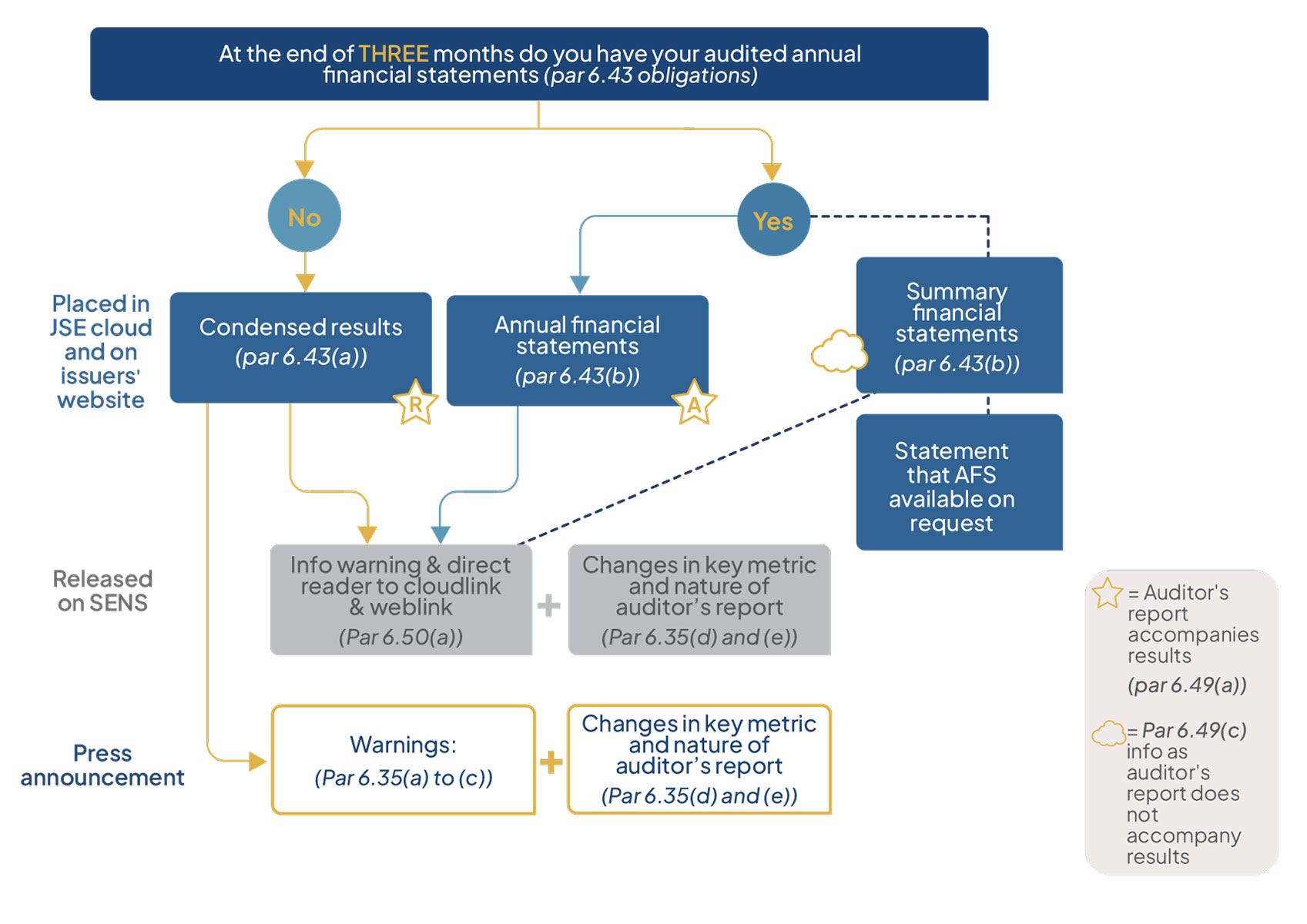
All Results require a Results Announcement on SENS, which announcement must contain the Short Form Press Announcement Details (as a minimum), a statement regarding investment decisions and two URLs – one being to the JSE cloudlink and the other being to the issuer's weblink – both referencing the full Results details.
Results Announcements for AR must contain the date, time and venue of the AGM and note that the AFS are available on the JSE cloudlink but that the JSE Governance Disclosures (see AR below) are only available on the issuer's weblink.
IFS, Second IFS and Cond AFS require a Short Form Press Announcement in the press (in one widely circulated daily newspaper, in any official language), disclosing the Short Form Press Announcement Details, being headlines in a prominent position, directors' responsibility, full announcement available on SENS and issuer's website, investment decisions to be based on full information, increases/decreases in revenue/profit, HEPS, EPS, dividend/distribution, NAV (if relevant) compared to the previous period and, if an auditor report is issued, the name of the audit firm and type of opinion/conclusion reached (including any modifications disclosed in full). In the case of a voluntary Short Form Press Announcement, it is recommended that the same information is provided.
Interim Periods Ended ("IPE") Results
IFS and/or Second IFS must be released within three months after the end of:
- the first six months of a financial year (IFS); and
- the old financial year‑end, if the old financial year‑end is extended (Second IFS) through a Results Announcement and a Short Form Press Announcement.
Failure to publish IFS or Second IFS within three months of the IPE will result in the JSE taking action on day 14 thereafter, being the annotation of the listing with an "RE" and a JSE issued SENS announcement warning of a suspension of trading (if publication is not effected by the end of month four). Failure to publish the IFS or Second IFS by the end of month four will result in suspension of trading in ListCo securities on the first trading day of month five. The lifting of the suspension will occur only once the IFS or Second IFS are released and the JSE is satisfied that there are no other problematic matters that must be resolved.
IFS do not require an audit or auditor review (voluntary review or audit determined by the Board). Second IFS require an audit review conclusion (voluntary audit determined by the Board).
JSE GAAP requires disclosure that accounting policies are consistent with previous AFS, HEPS, diluted HEPS and HEPS reconciled to EPS, a statement confirming compliance with IAS 34 and (if relevant) any material changes to contingent acquisition/disposal consideration, in respect of mineral ListCos, any material changes to mineral resources and reserves and other disclosures in the prior year AR and in respect of property entities: a report on any forecast made to the interim period ended.
The Audit Committee and Board must determine whether ListCo wishes to forecast in the prospects paragraph and, if so, ensure compliance with the forecast JSE LR.
Financial year end results
The JSE periodic financial reporting model focuses on disclosures: firstly, within three months of the financial year end and, secondly, within four months of financial year end.
Within three months of the financial year end ListCo must:1
- issue Cond AFS and effect a Results Announcement and Short Form Press Announcement; or
- issue AFS, usually being both Cons AFS and Co AFS, or only Cons AFS and effect a Results Announcement (but not a Short Form Press Announcement); or
- issue the AR including the AFS, being Cons AFS and Co AFS, and effect a Results Announcement (but not a Short Form Press Announcement); or
- issue AFS, being both Cons AFS and Co AFS, or Cons AFS and effect a Results Announcement (but not a Short Form Press Announcement) and issue the Notice of AGM accompanied by the AFS, Cons AFS or Summary AFS; or
- issue the AR including the AFS, being Cons AFS and Co AFS, and effect a Results Announcement (but not a Short Form Press Announcement) and issue a Notice of AGM accompanied by the AFS, Cons AFS or Summary AFS.
1 Does not apply to the general segment.
Cond AFS must be released through a Results Announcement and a Short Form Press Announcement. JSE GAAP requires disclosure in Cond AFS that accounting policies are consistent with previous AFS and disclosure of HEPS, diluted HEPS and HEPS reconciled to EPS.
Failure to publish the Cond AFS within three months of the year end will result in the JSE taking action on day 14 thereafter, being the annotation of the listing with "RE" and a JSE issued SENS announcement warning of a suspension of trading (if publication is not effected by the end of month four). Failure to publish by the end of month four will result in suspension of trading in ListCo securities on the first trading day of month five. The lifting of the suspension will only occur once the Cond AFS, AFS, Cons AFS or AR are released and the JSE is satisfied that there are no other problematic matters that must be resolved.
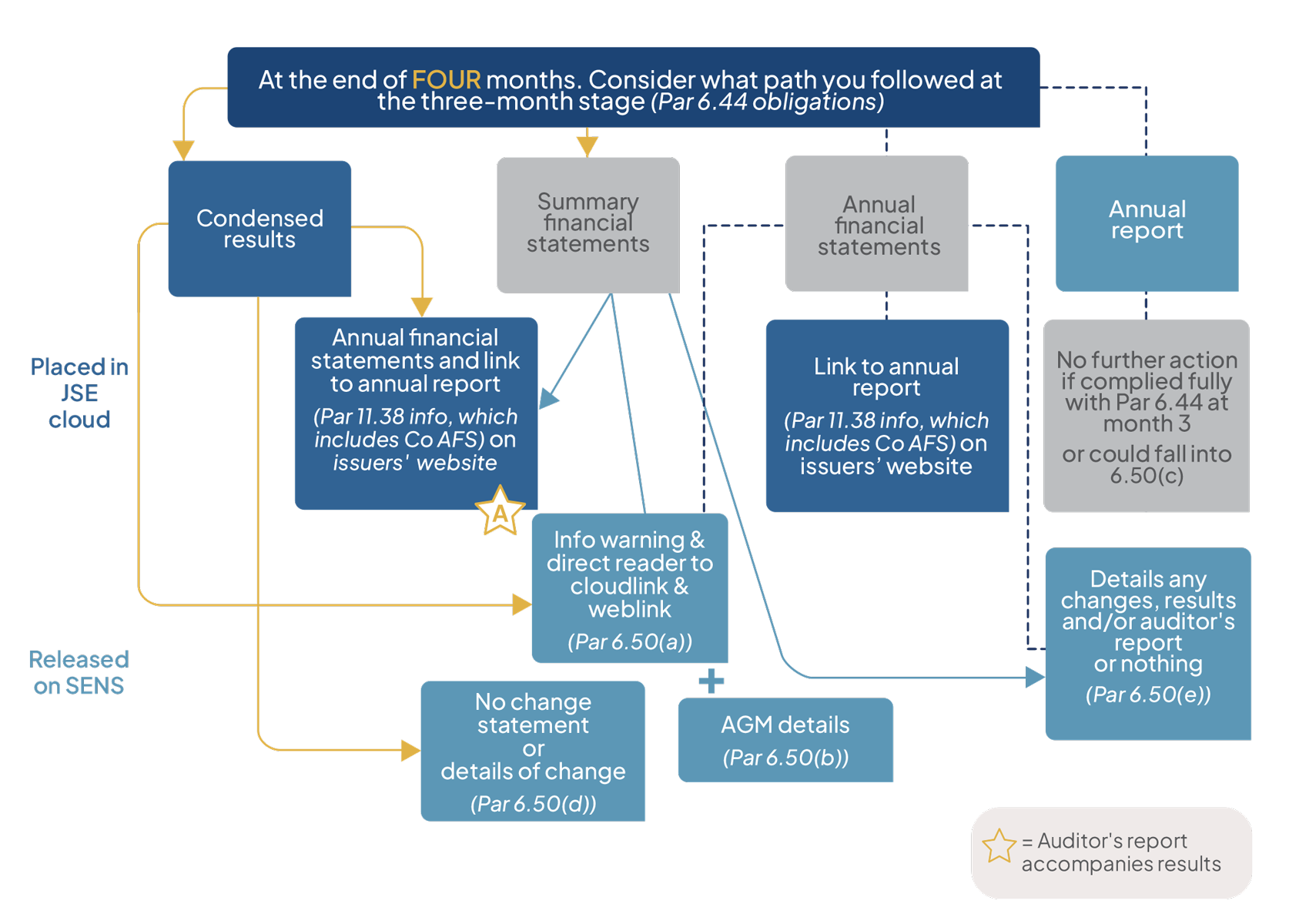
Within four months of the financial year end ListCo must:
- issue the AR if it was not issued within three months including the AFS, being Cons AFS and Co AFS and effect a Results Announcement (but not a Short Form Press Announcement), if (only) Cond AFS were issued within three months; or
- issue the AR if it was not issued within three months and effect a Results Announcement (but not a Short Form Press Announcement), if the AFS, being Cons AFS and Co AFS, were issued within three months; or
- issue the AR if it was not issued within three months together with the Co AFS, if only the Cons AFS were issued within three months (it appears that the Co AFS may not be issued in isolation within four months if the AR had been previously issued) and effect a Results Announcement (but not a Short Form Press Announcement); or
- effect one of the above scenarios and issue the Notice of AGM accompanied by the AFS, Cons AFS or Summary AFS.
Failure to publish both the AR and Notice of AGM within four months of the year end will result in the annotation of the listing with "RE" and a JSE issued SENS announcement warning of a suspension of trading (if publication is not effected by the end of month five) on trading day one of month five. Failure to publish by the end of month five will result in suspension of trading in ListCo securities on the first trading day of month six. It is expected that the lifting of the suspension will only occur once the AR and Notice of AGM are released/issued and the JSE is satisfied that there are no other problematic matters that must be resolved.
Financial year‑end results require the issue of Co AFS and Cons AFS (unless the JSE agrees otherwise). Usually both Co AFS and Cons AFS are included in one document, being the AFS. However, the Cons AFS may be issued in advance of the Co AFS (refer below).
JSE GAAP requires disclosure in the Cons AFS of the CEO and CFO attestation statement, unlisted securities information, HEPS, diluted HEPS and HEPS reconciled to EPS, ListCo's directors' beneficial interest in ListCo securities (including securities subject to pledge or similar security arrangement), major shareholder disclosure, public shareholder disclosure comprising public and non‑public interests (in accordance with the JSE LR definition of public shareholders but excluding the extended family of a director of ListCo) in ListCo securities, share incentive scheme options and shares balances, remuneration of ListCo directors (and prescribed officers in terms of the Companies Act), material changes to contingent acquisition/disposal consideration, issues of shares for cash details, repurchased equity securities details, restrictive funding arrangement details (if applicable), for Property Entities: segmental and individual property information and for investment trust entities: investment portfolio information.
The AFS (Cons AFS plus Co AFS) may form part of the AR. The AR is often titled the "Integrated Annual Report". It is possible to "break up" the periodic financial reporting year end documents into separately disclosed documents comprising Cons AFS, Co AFS, AR/IAR and Notice of AGM. Integrated reporting for ListCos is voluntary. The AR/IAR contains all disclosures not included in the AFS or Notice of AGM.
JSE GAAP requires disclosure in the AR/IAR of the application and disclosure regime of King (which may be incorporated via a weblink to ListCo's website) – now best effected through the King Disclosure Framework, the prior year results of the non‑binding remuneration resolutions in AGM and the results of any required engagements with shareholders, trading statement base line information (being historical or forecast EPS and HEPS and (if relevant) NAVps), specific CG disclosures (director capacity, director CVs, CEO and chairperson, FD, CoSec, Board committees, AuditCom, balance of power and diversity policy), a statement confirming compliance with both relevant laws of establishment (usually the Companies Act for SA domiciled public companies) and ListCo's MOI, disclosure of material risks (may be incorporated via a weblink), report on any material differences compared to a forecast made for the year ended, for mineral ListCos: mineral resources and reserves and other disclosures, separate Co AFS (if not issued prior to the issue of the AR), a weighted voting share structure, if applicable and reason for resignation/termination of AF, if applicable. Various other non‑GAAP disclosures (such as a chairman's report, CEO's report, CFO's report, sustainable reporting, and so on) will also be included as required by each ListCo.
If the Cons AFS or the AR (being the Cons AFS contained therein) is/are issued after publication of the Condensed AFS and the content of the Cons AFS or AR (being the Cons AFS contained therein) has not changed from the previously published content of the Condensed AFS, then a no-change statement must be included in the Results Announcement. If the content of the Cons AFS or the AR (being the Cons AFS contained therein) has changed from the previously published content of the Cond AFS, then a Change Statement must be included in the Results Announcement detailing and disclosing each Cons AFS line‑item change, individually and cumulatively.
If the AR (being the Cons AFS contained therein) is issued after publication of the Cons AFS (includes Summary AFS) and the content of the AR (being the Cons AFS contained therein) has changed from the previously published content of the Cons AFS (includes Summary AFS), then a Change Statement must be included in the Results Announcement detailing and disclosing each Cons AFS line item change, individually and cumulatively. Depending on the nature of such changes, this may require a withdrawal of the Cons AFS or a restatement and withdrawal of previous audit opinion.
ListCo must determine whether a forecast is to be included in the prospects paragraph of a short-form Report and if so, ensure compliance with forecast reporting.
ListCo must ensure that the annual compliance certificate is provided to the JSE, electronically, on the date of publication of the AR together with the AR.
ListCo must ensure that delivery of the Notice of AGM is effected using any of the delivery mechanisms allowed in the Companies Act, including delivery using non‑registered mail in terms of Section 6(9)(b) of the Companies Act.
ListCo must announce the date, time and venue of any GM/AGM within 24 hours of having delivered notice to shareholders.
ListCo must announce the results of resolutions voted upon in GM/AGM within 48 hours of GM/AGM, including any additions or amendments of resolutions.
| Listings Requirement | Summary of provision | ||
| Section 6 | Continuing obligations | ||
| 6.1 – 6.5 | Sponsors and announcements | ||
| All announcements must be in English and comply with Appendix 1 to Section 6. | |||
| Announcements must be disseminated via the JSE SENS platform and on ListCo's website, either simultaneously or after it has been announced. | |||
Main Board ListCo ("ListCo") must:
|
|||
| 6.6 | Conflicts | ||
| ListCo must comply with the JSE LR on a continual basis even if there is a conflict, unless specifically otherwise directed by statute or a court of law. | |||
| The Act is a "higher" law than the JSE LR and takes precedence in the hierarchy of laws.The Act is a "higher" law than the JSE LR and takes precedence in the hierarchy of laws. | |||
| 6.7 | Prescribed information to shareholders | ||
| ListCo must notify shareholders of GMs/AGMs that they are entitled to attend and enable entitled shareholders to exercise their voting rights, where applicable. | |||
| Release results, announcements and deliver circulars in terms of the JSE LR. | |||
| 6.15 – 6.41 | General continuing obligations | ||
| 6.19 | General obligation of disclosure | ||
| ListCo must determine whether information arising from any CA or any "not in the ordinary course of business" event qualifies as being PSI. | |||
| Practice Note 2/2015 must be applied in determining whether information qualifies as being PSI – this involves applying the metrics of size, importance and reasonable certainty. | |||
| PSI must be announced on SENS without delay (and usually in the press) unless it can be kept confidential. | |||
| 6.20 – 6.25 | Confidentiality and cautionary announcements | ||
| PSI may not be released other than on SENS during JSE trading hours. | |||
| PSI also qualifies as Inside Information in terms of the FMA and, in disseminating such information, ListCo must not commit the insider trading offence contained in Section 78(4). | |||
| If confidentiality of PSI cannot be maintained or is breached, an announcement is required immediately. | |||
| All information that is price sensitive or required to be disclosed in terms of the JSE LR that is going to be released in any meeting or presentation must be announced on SENS prior to commencement of such meeting or presentation. | |||
| An announcement of PSI must be effected as either a cautionary announcement (apply Practice Note 2/15) or a "terms" announcement (a terms announcement will contain all relevant information) if confidentiality is breached. | |||
| Cautionary announcements must be renewed every 30 bd, until full details of the information have been announced. | |||
| 6.26 – 6.33 | Trading statements | ||
| Trading Statements apply to two separate financial periods: the interim period and the financial year/period, on a mutually exclusive basis (period ending/ed). Excluding Property ListCos, when ListCo is reasonably certain that forecast EPS and/or HEPS for the relevant current period ending/ed will be greater than or less than – either the comparative historical prior (financial year) period EPS and/or HEPS or forecast EPS and/or HEPS for the current period ending/ed that were previously published as a specific forecast – then a trading statement must be announced on SENS. If more relevant (because of the nature of ListCo's business) net asset value per share ("NAVps") may be adopted. ListCo must announce this election in advance of the first period ending. | |||
| Trading statements may be range based, with a maximum range of 20% of comparative historical EPS and/or HEPS or forecast EPS and/or HEPS. Alternatively, trading statements may be based on a minimum stated increase or decrease for EPS and/or HEPS. A minimum-based trading statement requires a range-based trading statement to (eventually) be published prior to the period ended financial results being published. | |||
| When forecast EPS and/or HEPS fall outside the range of a published range-based trading statement or move materially "away" from a published minimum-based trading statement, a new trading statement must be published. The principles concerning PSI apply to the trading statement regime. | |||
| Section 11 | Financial information | ||
| These JSE LR deal with the requirements to issue reports of historical financial information ("RHFI"), reports of pro forma financial information ("PFFI") and profit forecasts/estimates reports ("PFE") in respect of CAs and the issuance of PFE ITOCOB. | |||
| RHFI include historical financial information disclosures for the last three financial years for new ListCos, two years for Cat 1 transactions for new ListCos, two years for Cat 1 transactions for ListCos and one or two financial years for ALTx ListCos and are only ever issued as part of a Circular, PLS or Prospectus with Audit Persons review sign off (long form). | |||
| PFFI reports show the effect of CA financial effects on RHFI and are able to be issued in long form or as part of an announcement only, which does not require RA sign off (short form). PFE includes all forecasts and estimates and can be issued in long or short form. PFE includes Trading Statements, General Profit Forecasts and Specific Profit Forecasts. PFE in short form is typically included in the results paragraph of a Results Announcement. | |||
| Minimum contents of reports | |||
| Condensed AFS and Summary AFS must be prepared in compliance with IFRS (IAS 34), Financial Pronouncements as issued by the Financial Reporting Standards Council, the South African Institute of Chartered Accountants ("SAICA") Financial Reporting Guides, the Companies Act and any required JSE accounting disclosures ("JSE GAAP") ("collectively "All GAAP"). | |||
| Interim Results must be issued and presented in accordance with All GAAP (JSE GAAP includes specific disclosures regarding material changes to contingent consideration, Mineral Companies disclosures, Property Entities disclosures). | |||
| Confirmation of consistent accounting policies and HEPS, diluted HEPS and HEPS reconciled to EPS. | |||
| Change of financial year | |||
| Notification of the proposed year end must be given to the JSE and confirmation of the period covered agreed. | |||
| Minimum content of AFS | |||
| AFS are the Cons AFS. | |||
| AFS must be compliant with All GAAP. | |||
| JSE GAAP requires disclosure of the CEO and CFO attestation statement, unlisted securities information, HEPS, diluted HEPS and HEPS reconciled to EPS, ListCo's directors' beneficial interest in ListCo securities (including securities subject to pledge or similar security arrangement), major shareholder disclosure, public shareholder disclosure comprising public and non-public interests (in accordance with JSE definitions but excluding the extended family of a director of ListCo) in ListCo securities, share incentive scheme options and shares balances, remuneration of ListCo directors (and prescribed officers in terms of the Cos Act), material changes to contingent acquisition/disposal consideration, issues of shares for cash details, repurchased equity securities details, restrictive funding arrangement details (if applicable), for Property Entities, segmental and individual property information and for investment trust entities, investment portfolio information. | |||
| Additional content for Annual Reports | |||
| The AR requires JSE Governance Disclosures detailing the general adoption and application of the King Code, prior year results of the non-binding remuneration resolutions and the results of any required engagements with shareholders, base line trading statement information if not EPS and HEPS, specific CG disclosures, a statement confirming compliance with both relevant laws of establishment (usually the Cos Act for SA domiciled public companies) and ListCo's MOI, disclosure of material risks (which risks may be incorporated via a weblink to the website of ListCo), report on any material differences compared to a forecast made for the year ended, for Mineral ListCos, mineral resources and reserves and other disclosures, for Property Entities, disclosure of a JSE or IFRS valuation (whichever is relevant) and confirmation of compliance with a specific risk management policy, Co AFS (if not issued prior to the issue of the AR). | |||
| Various other non-GAAP disclosures (such as a chairman's report, CEO's report, CFO's report, sustainable reporting, and so on) will also be included as required by each ListCo. | |||
| FRIP | |||
| Any suspected non-compliance with IFRS and JSE GAAP may be investigated by the JSE itself or referred to the FRIP for investigation and a recommendation back to the JSE. Non-compliance will result in censure in terms of Section 1, possible publication of information and possible referral of any involved CA(SA)s to SAICA or the IRBA for disciplinary proceedings. | |||
| 6.34 & 6.35 | Press announcements | ||
| Mandatory press publication requires publication in a widely circulated daily newspaper, in any official language. | |||
| Publication in the press can be in the format of a short-form announcement. | |||
| 6.36 – 6.38 | Appointment of auditor | ||
| Appointment of AFs and AIs (collectively "Audit Persons" ("APs")): ListCo may only appoint APs that are registered with IRBA and in good standing and have been "accredited" by ListCo's Audit Committee. | |||
| Any Audit Person that loses IRBA registration must notify ListCo within 48 hours and be replaced by ListCo within 90 days. | |||
| SubCos of ListCo are not required to be audited unless so required in terms of the Companies Act or ListCo's MOI. | |||
| The JSE LR apply to foreign domiciled primary listed ListCos and to foreign domiciled APs, subject to any exemptions provided by the JSE. | |||
| 6.39 – 6.41 | Notifications in respect of the auditor | ||
| Notification to the JSE and SENS announcement, within two business days of notification, of change of auditor details including (a) who initiated the change, (b) the reasons for the change, (c) effective date of the change, and (d) the name of the new AF/partner or a statement that ListCo is in the process of identifying a new AF. | |||
| 6.42 – 6.52 | Disclosure obligation of results | ||
| 6.42 | Restatement of previously published results | ||
| A restatement of previously published financial results requires notification to the JSE upon submission of the AR and annual compliance certificate to the JSE, in terms of Practice Note 3/2017. | |||
| 6.43 & 6.44 | Annual results | ||
| Within three months of financial year end, ListCo must issue Condensed AFS or Cons AFS. | |||
| Within four months of financial year end and at least 15 bd before the AGM, ListCo must release the AR (including Co AFS) and Notice of AGM. | |||
| 6.45 & 6.46 | Interim and quarterly reports | ||
| Interim Results are required to be released within three months on SENS and in the press for the six-month interim period ended ("Interim Period") and for the 12-month period ended ("Second Interim Period") if ListCo extends its financial year end. | |||
| Interim Periods ended give rise to financial closed periods, which then cease upon publication of the relevant Interim Results. | |||
| ListCos that voluntarily choose to be "Quarterly" reporters will publish quarterly reports after each financial quarter period ended. | |||
| Quarterly periods ended also give rise to financial closed periods, which then cease upon publication of the quarterly report. | |||
| If an interim report is not published within three months of the interim period ended, ListCo's shares are annotated within 14 days and the JSE issues a SENS announcement, and if the interim report is still not published by the end of the fourth month, ListCo's securities are suspended, which suspension will only be lifted after publication of the interim report. | |||
| 6.47 – 6.49 | Auditors' report | ||
| Audit opinions are required for AFS, Cons AFS and Co AFS. | |||
| Auditor review conclusions are required for 12-month Interim Results and Condensed AFS. | |||
| All auditor reports must comply with IAS and effect required disclosures in each report. | |||
| 6.50 | Results announcement | ||
| Include two accessible URLs – JSE cloudlink and ListCo's weblink. | |||
| AFS available through JSE cloudlink but additional information only available through ListCo's weblink. | |||
| Investment decisions should be based on actual results. | |||
| AR released after Condensed AFS or Cons AFS/Summarised AFS require either a no-change statement or a change statement with line-item details. | |||
| 6.51 | Procedure for non‑compliance | ||
| Failure to issue Interim Results or Condensed AFS within three months of period end will result in suspension of trading on day one of month five. | |||
| Failure to issue the AR or Notice of AGM within four months of year end will results in suspension of trading on day one of month six. | |||
| 6.52 | Modified auditors' report | ||
| Auditors' reports issued with modification result in annotation of listing of E, G, Q, A or D. | |||
| A or D qualifications require the JSE to consider suspension and possible subsequent removal of trading. | |||
| 6.53 & 6.54 | Disclosure of beneficial interest in securities | ||
| Maintain a register of disclosures as per section 56 of the Act. | |||
| After receipt of notice of share dealing(s), ListCo must announce the information as per section 122 of the Act. | |||
| 6.55 | Cash company | ||
| This classification may lead to suspension/removal of listing. | |||
| 6.56 – 6.60 | Pyramids | ||
| Existing pyramid companies listed at date of approval of the pyramid provisions remain unaffected. | |||
| ListCos have two years to remedy their classification as a pyramid company – if ListCo is not declassified as a pyramid after two-year period, its listing may be removed by the JSE. | |||
| 6.61 – 6.70 | Meetings | ||
| 6.61 & 6.62 | Announcement of AGM/GM and written resolution details | ||
| Within 24 hours of delivery of the notice of meeting to shareholders, ListCo must release an announcement including date, time, and venue of AGM/GM. | |||
| If proposing written resolutions, within 24 hours of delivery of the written resolutions to shareholders, ListCo must publish an announcement detailing the written resolution. | |||
| 6.63 & 6.64 | Disclosure of voting results of annual/general meetings/written resolutions | ||
| ListCos must release an announcement within 48 hours after each GM/AGM or conclusion of voting in respect of a written resolution, providing details of the voting results. | |||
| 6.65 & 6.66 | Demand to call a shareholders' meeting | ||
| When ListCo receives a request to call a shareholders' meeting in terms of section 61(3) of the Act (or for a foreign applicant issuer with a primary listing in terms of similar statute) ListCo must notify the JSE immediately and release an announcement. | |||
| A notice of meeting must be issued within 10 bd from date of receipt of the request and the meeting must take place within 25 bd from the date the notice of meeting is issued. | |||
| 6.71 – 6.97 | Directors | ||
| 6.71 – 6.73 | Changes to the Board and CoSec | ||
| Appointment, resignation, removal, retirement, death, change of important functions and change of executive responsibilities require SENS disclosure within 24 hours of knowledge. | |||
| 6.74 – 6.76 | Directors and CoSec declaration | ||
| Schedule 1 requires completion and submission of the director's declaration by newly appointed directors to the JSE within 14 days of appointment. | |||
| Form B2 (available on JSE Forms Portal) must be submitted to the JSE within 14 days of appointment regarding a new CoSec appointment. | |||
| 6.77 – 6.80 | Dealing in securities | ||
| Directors, prescribed officers and the CoSec of ListCo and the directors and CoSec of major SubCos of ListCo (SubCos that account for 25% of group revenue or group gross assets) are subject to compliance with Directors' Dealings ("Affected Director"). | |||
| Dealings are broadly defined and include actual or agreed future purchases, sales, pledges or similar security arrangements (which requires further disclosure at various stages of such arrangement) and subscriptions of ListCo's listed securities or derivatives in respect thereof (including share incentive schemes that are equity settled) ("Directors' Dealings"). | |||
| ListCo must announce all Directors' Dealings on SENS within 24 hours of receiving notification from the Affected Director. | |||
| Breaches in respect of not obtaining approval or effecting required notifications result in a JSE censure and penalty against the Affected Director. | |||
| 6.81 & 6.82 | Dealings in prohibited periods | ||
| Affected Directors may not effect Directors' Dealings in PP (being Price Sensitive and/or Closed Periods). | |||
| 6.83 – 6.85 | Clearance to deal | ||
| Directors' Dealings by Affected Directors require approval from ListCo's chairperson (or a committee). After dealing, notification is required by the Affected Director to ListCo within 3 bd with all relevant details. | |||
| 6.86 – 6.89 | Dealings by associates of directors and investment managers | ||
| Associates of Affected Directors are free to effect Directors' Dealings in any period, but must notify the Affected Director concerned of the dealing within 24 hours of dealing. Affected Directors then have 3 bd to subsequently notify ListCo and ListCo then has 24 hours to announce on SENS. Affected Directors are required to pre-notify their associates that they are Affected Directors. | |||
| 6.90 | Dealings by share incentive schemes | ||
| The Directors' Dealings requirements apply mutatis mutandis to any equity settled share incentive scheme subject to non-Affected Director persons ("participants") being able to deal in vested securities during PP. The effect of this rule is that new/fresh issues of options, rights or securities may not be made to any participants or Affected Directors during a prohibited period. | |||
| 6.92 – 6.96 | Business rescue | ||
| If ListCo is placed in business rescue in terms chapter 6 of the Act, it must release an announcement immediately. | |||
| 6.97 | Court applications | ||
| ListCo must notify the JSE immediately of any application in terms of section 163 of the Act. |